
For businesses running services across multiple sites or employing a distributed field workforce, calendar synchronization is a constant headache. Many owners attempt to solve this by linking multiple Google Calendars or importing external iCal feeds. Because these imports rely on slow polling intervals that sometimes check for updates only once every 15 to 30 minutes, they frequently fail to catch changes in real time, leading to double-booked appointments.
The Latency of Polling Systems
In computer science, managing access to shared schedules is a classic database transaction concurrency problem. A paper published by the Association for Computing Machinery (ACM) on Distributed Consensus protocols highlights that relying on asynchronous periodic sync loops (like standard iCal imports) introduces a synchronization lag. If a patient books a slot at clinic A, and another patient queries the same therapist's availability for clinic B two minutes later, the system displays the slot as open because the database sync hasn't run. This creates scheduling conflicts that admin teams have to resolve manually.
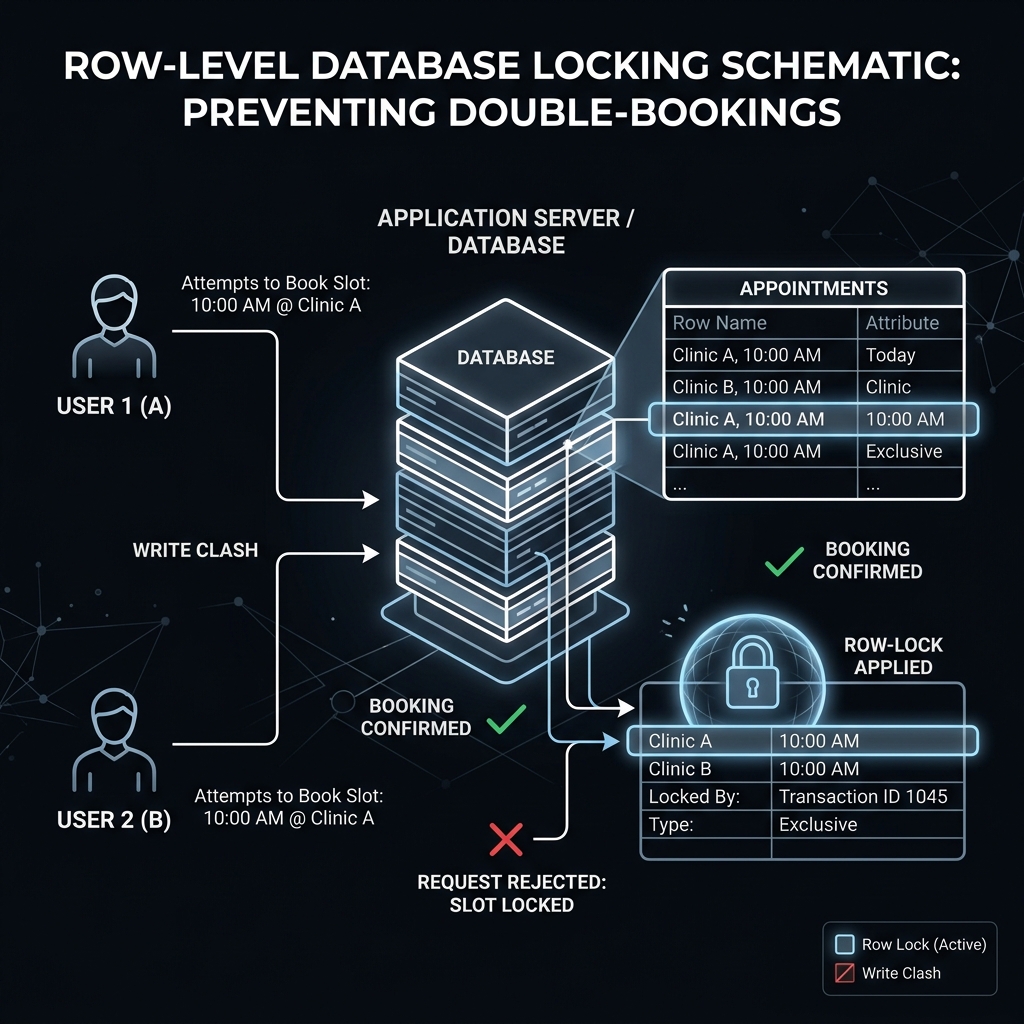
Relying on Google Calendar's periodic sync loop to manage live customer booking queries is not synchronization. It's a race condition.
Implementing Row-Level Write Locks
To guarantee scheduling integrity, booking queries must operate directly on a central database, executing an immediate row-level write lock when a slot is queried. Below is a SQL transaction script demonstrating how to check for slot availability and apply a row-level lock (`FOR UPDATE`), preventing concurrent checkout queries from creating double bookings:
BEGIN;
-- Select and lock the slot to prevent concurrent transactions
SELECT id, status
FROM service_slots
WHERE date_time = '2026-05-28T14:00:00Z' AND provider_id = 42
FOR UPDATE;

-- If status is 'available', proceed with booking write
UPDATE service_slots
SET status = 'booked', customer_id = 109
WHERE date_time = '2026-05-28T14:00:00Z' AND provider_id = 42;
COMMIT;
By replacing async calendar polling with row-level locks, scheduling conflicts are completely eliminated, protecting patient retention and staff efficiency.