
Most online booking systems use a basic calendar grid. A customer selects a service, views a list of open times, and books whatever slot is free. While this works for static desk jobs, it creates logistical chaos for field service businesses. If a technician has a 9:00 AM booking on the north side of town and a 10:30 AM booking on the south side, they spend their day stuck in traffic instead of billing hours.
The Vehicle Routing Optimization Problem
In operations research, this is known as the Vehicle Routing Problem (VRP) with Time Windows. Research from the MIT Operations Research Center highlights that manual scheduling or unconstrained calendar grids lead to a 20% to 35% loss in operational capacity due to inefficient transit routes. When you let customers pick any open slot, they pack your schedule randomly. This drives up fuel costs, puts wear on vehicles, and limits the number of jobs your team can handle per day.
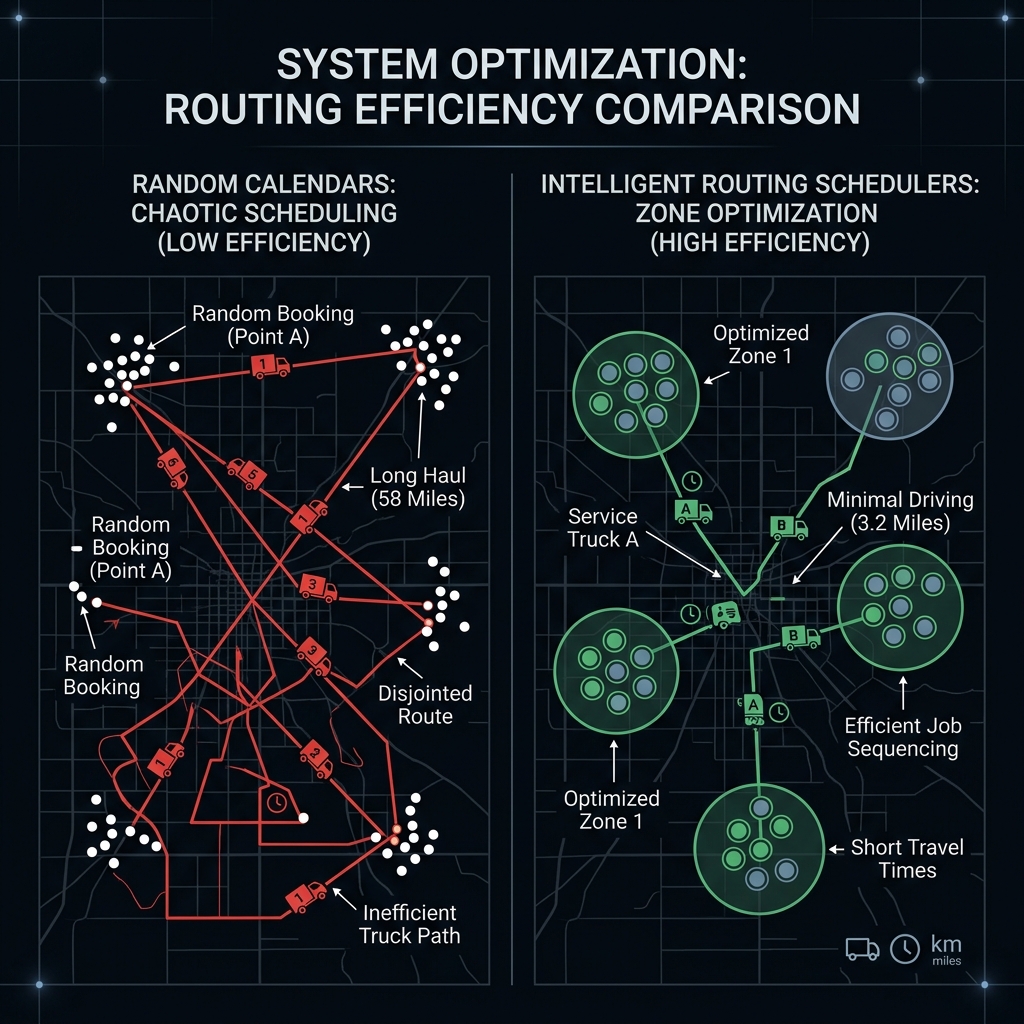
An unconstrained calendar grid turns your dispatch team into traffic coordinators. A smart booking engine calculates drive times before showing slots.
Querying Geographic Proximity Constraints
To solve this, a custom booking engine must filter slots by geographical clusters. Below is a JavaScript helper showing how to calculate the straight-line distance (using the Haversine formula) between a new booking request and an existing scheduled technician, ensuring that slots are only displayed if they are within a 15-mile routing radius of the tech's current schedule:
function getDistance(lat1, lon1, lat2, lon2) {
  const R = 3958.8; // Radius of the Earth in miles
  const dLat = (lat2 - lat1) * Math.PI / 180;
  const dLon = (lon2 - lon1) * Math.PI / 180;
  const a = Math.sin(dLat/2) * Math.sin(dLat/2) +
            Math.cos(lat1 * Math.PI / 180) * Math.cos(lat2 * Math.PI / 180) *
            Math.sin(dLon/2) * Math.sin(dLon/2);
  const c = 2 * Math.atan2(Math.sqrt(a), Math.sqrt(1-a));
  return R * c; // Distance in miles
}
If no inspector is in that zone on a given day, the engine suggests days when an inspector is scheduled nearby, offering a small 'green discount' to incentivize the customer to choose that slot. This change reduced average daily travel times by 42% per inspector, allowing the company to handle 1.5 more inspections per day with the same staff, adding $18,000 in weekly capacity.