
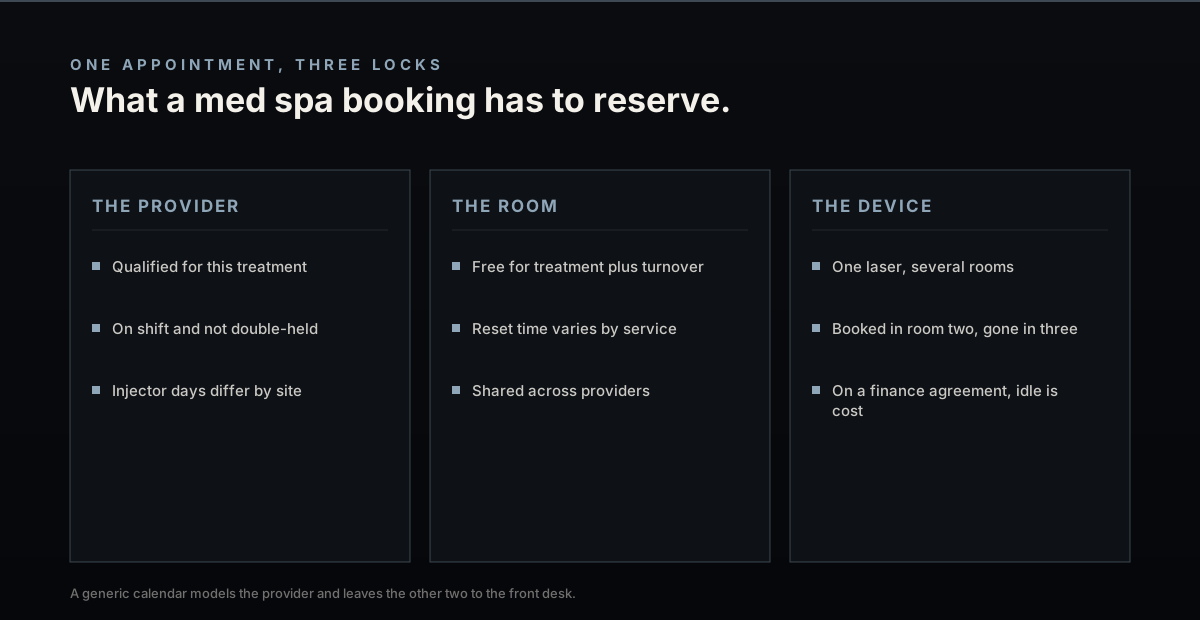
A med spa runs three scarce things at once: providers, rooms, and devices. A generic booking tool models one of them, usually the provider, and leaves the other two to whoever is at the front desk. That is why the schedule looks fine at nine in the morning and is being rebuilt by hand at eleven.
The revenue consequence is specific. An hour lost in an aesthetics practice is not an hour of a stylist's time. It is an hour of a room, a device on a finance agreement, and a provider whose time carries the highest cost in the building.
The Constraints a Calendar Cannot See
- One device, several rooms. A laser booked in room two is unavailable in room three, and no shared calendar knows that unless someone taught it.:
- Provider scope. An aesthetician cannot deliver an injectable. A booking page that lists every service against every provider will sell an appointment nobody on shift can perform.:
- Treatment intervals. Some courses have a minimum gap between sessions. Booking inside that window is a clinical problem before it is a scheduling one.:
- Consultation to treatment. A consult that does not convert has still consumed a room. Consults need their own duration, their own follow-up, and their own conversion number.:
- Turnover and cleaning. The treatment is 30 minutes. The room is occupied for 45. Padding rules that live in a person's head disappear on the busiest day.:
- Intake and consent. Forms that arrive on the day cost provider time. Forms that arrive before the appointment do not.:
Every one of these can be handled by a competent front-desk manager. That is the actual state of most practices, and it works right up to the point that person is on holiday, or the practice adds a second location, or the schedule gets dense enough that catching conflicts stops being possible.
No-Shows Are a Deposit Problem
Reminder sequences reduce no-shows. Deposits reduce them further, because the customer has money at stake and because taking one filters out the booking that was never serious. The mechanism only works when the deposit is collected inside the booking flow. A payment link sent afterwards is a second decision, and the people most likely to miss the appointment are the ones least likely to make it.
That is a hard requirement on the software. Payment, cancellation terms, and the rules for what happens to a deposit when someone reschedules within the window all have to be part of the same transaction that reserves the slot. We looked at the wider version of this in the analysis of what attendance actually costs.
A cancelled appointment you can refill is an inconvenience. A no-show at 4pm on a Thursday is a room, a device, and a provider, all paid for and all idle.
What Vertical Software Does Well, and Where It Stops
Aesthetics platforms exist and several are good. They handle charting, consent, and inventory, and for a single-location practice with a standard menu they are usually the right call. Buying is faster than building and the monthly fee buys ongoing compliance work you would otherwise own.
The limits show up in the same three places every time. Your service menu has to fit their model of a service. Multi-location resource sharing is often weak, because the product was designed around one site. And the customer record, including the treatment history that determines what someone is worth over five years, lives in their database on their terms.
For a practice with one location and a conventional menu, that trade is fine. For a group with shared devices, travelling injectors, or a membership model the platform does not recognize, the workarounds start to outweigh the saving. That is the same build-versus-rent line we drew for CRMs.
What a Built System Models Instead
- Services defined by what they require, so booking a treatment reserves the provider, the room, and the device together or not at all.:
- Provider qualifications as data, so the booking page cannot offer what the person on shift cannot deliver.:
- Deposits and cancellation terms enforced at the point of booking, with the reschedule rules written into the system.:
- Intake and consent collected before arrival, attached to the customer record.:
- Membership and package balances tracked against the customer, so front desk is not counting sessions in a spreadsheet.:
- A record of every customer, every treatment, and every interval, in a database you own and can export in full.:
None of that is exotic. It is a booking engine that models the practice instead of a calendar, sitting on a database designed for the job. The point is that the rules apply automatically at two in the afternoon on the busiest day of the month, which is exactly when the human version fails.