
For field service operations such as plumbing, security setup, and electrical repair, dispatching is a major operational bottleneck. Most businesses rely on an admin coordinator to look at booking cards, drag-and-drop slots onto a calendar, and text addresses to technicians. This manual scheduling leads to techs driving across town between calls, increasing travel times and reducing job capacity.
Heuristics in Vehicle Dispatching
Research from the INFORMS Journal on Applied Analytics shows that manual field routing leads to a 15% to 22% loss in travel efficiency due to poor scheduling. Without software calculating drive times and route patterns, admins tend to schedule based on staff preference or booking order rather than geographical efficiency. Techs end up driving past each other on opposite sides of town, wasting fuel and billable time.
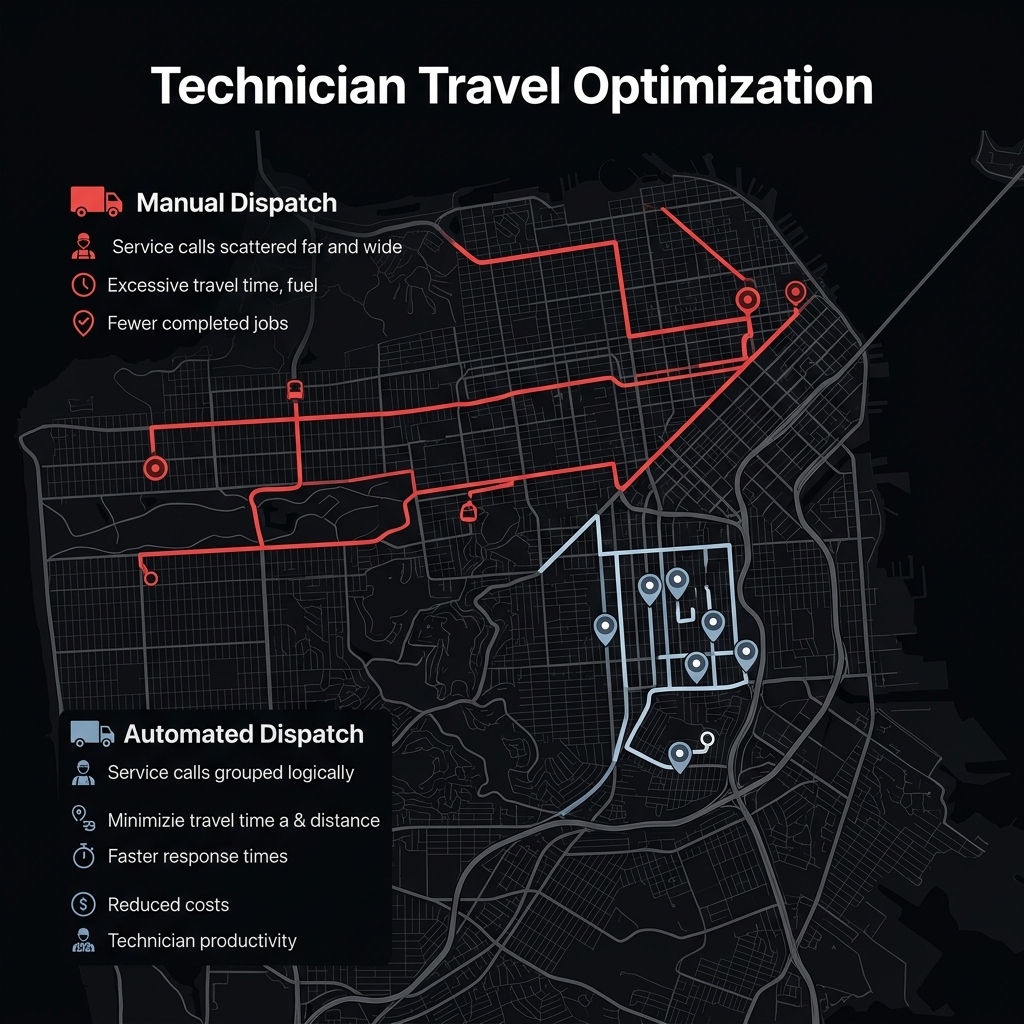
If your technicians spend more than 20% of their day in transit, you are running a driving business, not a service business.
Querying Available Technicians by Distance
To build a geographically optimized schedule, your dispatch engine must query technician coordinates. Below is a SQL query showing how to find the closest active technician to a new job request based on latitude and longitude coordinates:
SELECT id, name,
  (3959 * acos(cos(radians($1)) * cos(radians(latitude)) * cos(radians(longitude) - radians($2)) + sin(radians($1)) * sin(radians(latitude)))) AS distance
FROM technicians
WHERE status = 'active'
ORDER BY distance ASC
LIMIT 1;
By integrating this geographic routing logic, you reduce travel times, save on fuel and vehicle wear, and increase daily job capacity without adding headcount.