
Nobody can quote a booking system from the phrase booking system. The range is genuinely wide, and the reason is that the words describe a customer-facing outcome instead of a piece of software. What sets the number is how many constraints the system has to reason about, and how many other systems it has to agree with.
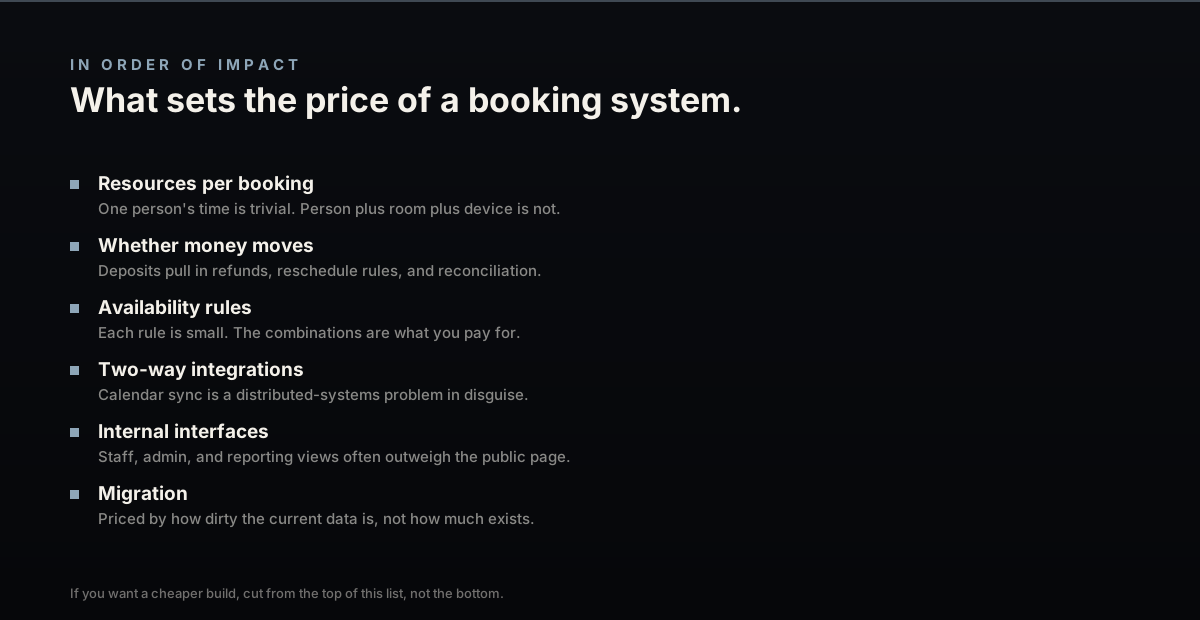
These are the variables in the order they usually move the total. If you want a cheaper build, this is also the order to cut in.
One: How Many Things a Booking Reserves
Reserving one person's time is close to trivial. Reserving a person, a room, and a device at the same time, where each has its own availability and its own rules, is a different class of problem. Every additional resource that has to be free simultaneously makes both the availability calculation and the conflict handling harder, and that work is most of the engineering in a booking engine.
This is the single biggest lever. A business that can honestly say a booking reserves one thing should not pay for a system that handles three.
Two: Whether Money Moves
Taking a deposit at booking pulls in a payment provider, refund handling, the rules for what happens when someone reschedules inside the cancellation window, failed payments, and a reconciliation path so the finances match the schedule. It is worth doing because deposits are the strongest no-show control available, but it is not a checkbox.
Three: How Complicated Availability Is
- Fixed slots on a repeating pattern is the cheap end.:
- Variable duration by service type adds a layer.:
- Prep and turnover padding adds another, especially when it differs by service.:
- Staff qualifications, so only some people can deliver some services.:
- Buffers, blackout periods, minimum notice, and maximum booking horizon.:
- Multiple locations with resources that move between them, which is the expensive end.:
Each rule is small on its own. The cost is combinatorial, because they interact and every combination has to produce a sensible answer.
Four: What It Has to Talk To
Integrations are consistently underestimated. A two-way calendar sync is not a feature, it is a distributed systems problem with conflict resolution in it. Practice management systems, accounting packages, and messaging providers each carry their own authentication, rate limits, and failure modes.
The question to ask about each integration is whether it has to be two-way. One-way is dramatically cheaper and is often enough.
Every integration is a promise that two systems will agree forever. That promise is the part you pay for.
Five: Who Else Has to Use It
A customer-facing booking page is one interface. A staff view, an admin view for the office, and a reporting surface for the owner are three more, each with its own permissions. Businesses often discover late that the internal tooling is larger than the public part, because the public part only has to do one thing well.
Six: Migration
Moving existing customers and bookings across is its own project, and its cost is set by how clean the current data is. Duplicates, inconsistent formats, and records that live partly in a spreadsheet all have to be resolved before import, because importing the mess reproduces it. We wrote about why that clean-up is worth doing properly in the piece on duplicate records.
What Reduces the Number
- Cut resource types. If a room is almost never the constraint, do not model rooms.:
- Make integrations one-way until a two-way version proves necessary.:
- Launch with one location and one service category, then extend.:
- Use a hosted payment page instead of an embedded flow.:
- Keep reporting to the numbers you will act on, not the ones that would be interesting.:
- Defer the customer-facing account area. Most bookings do not need a login.:
The general rule holds here as everywhere: the expensive part of software is not building it, it is the number of distinct situations it has to handle correctly. Scope the situations and the cost follows. The same logic applies to a website build, where the drivers are different but the arithmetic is the same.
The Comparison That Matters
Against an off-the-shelf product, the honest comparison is total cost over three years, including subscription and per-user fees, plus the operational cost of the workarounds you are running because the product does not fit. Most businesses have never priced the workarounds, which is why buying always looks cheaper than it is. It frequently still wins, and when it does that is the right answer.