
Service businesses scaling toward mid-market operations often accumulate software tools. It starts as a practical response to growth: you add one subscription for calendars, another for CRM, a third for automated emails, a fourth for team communications, and a fifth to link them. Over time, you build a complex web of subscriptions that drains profit margins.
The High Cost of SaaS Sprawl
A McKinsey & Company report on operational efficiency identifies 'app sprawl' as a significant driver of administrative overhead. The costs aren't limited to monthly software license fees. They also include integration costs, data entry workarounds, and subscription creep. As your staff grows, seat licenses scale linearly. When you use five separate tools, you pay five times for the same user.
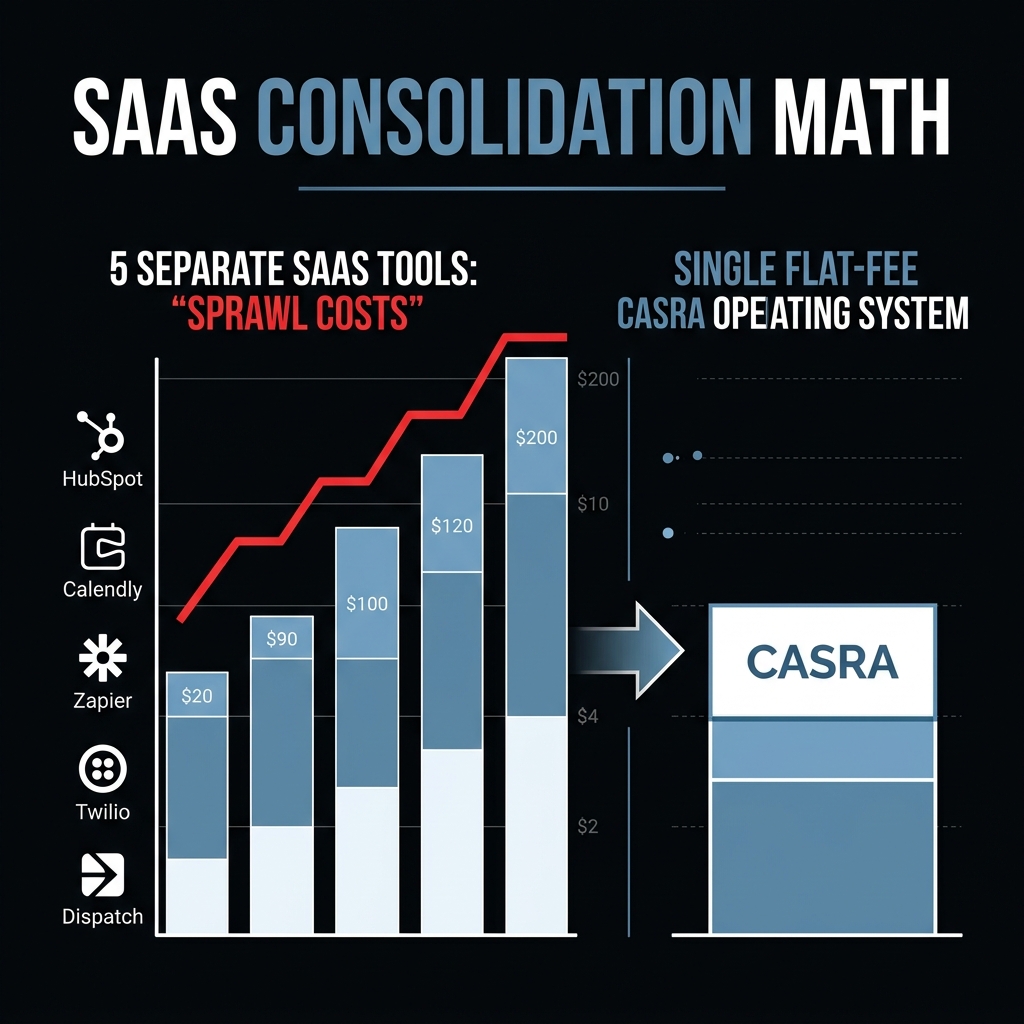
Furthermore, connecting these tools requires middleware like Zapier. As transactional volume grows, task usage costs compound. If you run 20,000 tasks a month, you are paying hundreds of dollars just to sync data between your own subscriptions.
Paying software vendors to pass data between tools you already pay for is a structural tax on your operating efficiency.
The $3M Operations Balance Sheet
Let's look at the software audit of a $3M plumbing and electrical provider. They were running HubSpot CRM ($500/mo), Calendly ($80/mo), ActiveCampaign ($350/mo), Twilio ($120/mo), Zapier ($250/mo), and a dispatch scheduler ($400/mo). With seat licenses for 12 admins and technicians, their total software bill exceeded $2,200 a month. More importantly, 15% of their admin team's week was spent manually cross-referencing customer data between Calendly, HubSpot, and their dispatch system to fix booking errors.
By consolidating these functions into a single self-hosted CRM and booking system built on their own database, they eliminated seat fees, removed Zapier tasks, and saved $1,800/month in licensing costs. More critically, they freed up 30 hours a week of manual admin labor, allowing the team to focus on dispatch logistics instead of data entry.