
The traditional custom software agency model is fundamentally misaligned with business health. Agencies generate profit by maximizing billable development hours. The customer, conversely, needs simple, permanent operational layers that require zero ongoing development. This conflict drives agencies to construct bespoke, over-engineered codebases from scratch, creating a high maintenance load that requires them to be kept on retainer indefinitely.
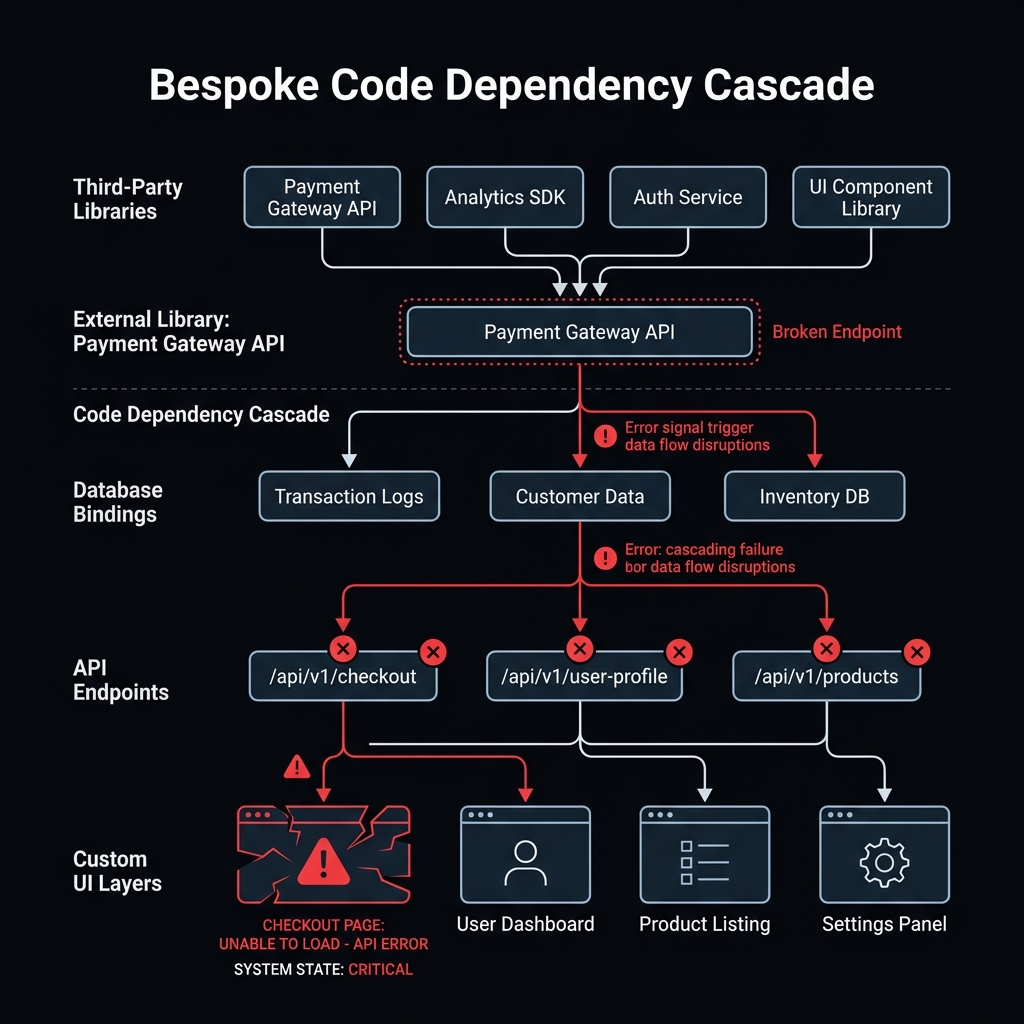
The Bespoke Code Dependency Cascade
When an agency builds a project, they write hand-wired connectors to link frontends, APIs, databases, and third-party libraries. This setup is highly vulnerable to software decay. Modern software stacks rely on hundreds of nested open-source packages. If a single library updates its security protocols, or a third-party API deprecates an endpoint, the connections cascade into errors, breaking core features. Without developer oversight, the custom site collapses.
Analyzing Software Project Failures
The Standish Group's CHAOS Report, an ongoing study tracking over 50,000 software projects globally, reveals that only 16.2% of custom software projects are completed on time and on budget. Over 52% of projects cost 189% of their original estimate, and 31.1% are cancelled entirely before completion. The primary cause of failure is the lack of standardized modules. By starting every project from scratch, developers introduce new bugs, leading to endless debugging cycles.
If your core operating system requires custom coding just to change a scheduling link or sync an invoice, you haven't bought infrastructure. You've bought a liability.
The Solution: Hardened Relational Schemas
To avoid software decay, systems must be built on standardized, hardened relational database structures instead of hand-wired scripts. A custom CRM database should map to clean SQL tables with native integrity constraints. Below is a sample PostgreSQL schema illustrating how to design customer and dispatch tables with native foreign keys, preventing data duplication and routing errors:
CREATE TABLE customers (
  id SERIAL PRIMARY KEY,
  first_name VARCHAR(50) NOT NULL,
  last_name VARCHAR(50) NOT NULL,
  email VARCHAR(100) UNIQUE NOT NULL,
  phone VARCHAR(20) UNIQUE NOT NULL,
  created_at TIMESTAMP DEFAULT CURRENT_TIMESTAMP
);

CREATE TABLE service_bookings (
  id SERIAL PRIMARY KEY,
  customer_id INT REFERENCES customers(id) ON DELETE CASCADE,
  scheduled_time TIMESTAMP NOT NULL,
  status VARCHAR(20) DEFAULT 'scheduled',
  assigned_tech_id INT,
  geo_coordinates POINT,
  created_at TIMESTAMP DEFAULT CURRENT_TIMESTAMP
);
By establishing standardized database schemas, businesses ensure their customer data remains structured and isolated. The user interface can change, but the underlying data remains secure, readable, and permanent.