
Legal intake has an unusual property: the value of one matter is large enough that a single lost inquiry can exceed a year of software spend. That changes the arithmetic on everything below, and it is why intake deserves engineering attention that a lower-ticket business could not justify.
It also has an unusual failure mode. The people contacting a firm are frequently in distress, contacting several firms, and deciding on the first one that responds like it is competent.
Failure One: The Inquiry That Waits
An inquiry submitted on Friday evening that gets a reply on Monday morning has usually already retained someone else. This is not a diligence problem. It is a coverage problem, and coverage is what software is for.
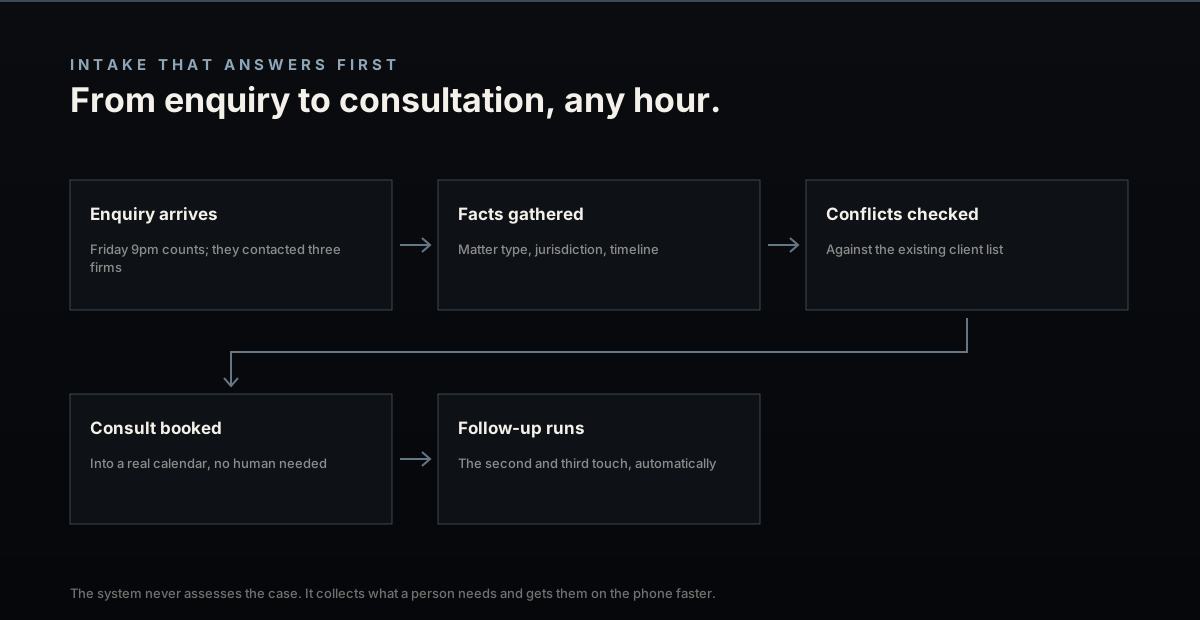
The fix is an intake path that acknowledges immediately, captures the facts that determine whether the matter is viable, and books the consultation into a real calendar without a human in the loop. Everything urgent is handled by the system; everything nuanced is handed to a person with the context already gathered. The general case for this is in the speed-to-lead analysis, and legal is the version where the numbers are largest.
Failure Two: The Consultation That Should Not Have Happened
An unqualified consultation costs an hour of the most expensive time in the firm, and it is caused by an intake form that asks for a name, an email, and a message. That form cannot tell a viable claim from a matter outside your practice areas, outside the limitation period, or with a conflict.
- Practice area routing, so a family matter never lands in the personal injury queue.:
- Jurisdiction and limitation screening, asked as questions the inquirer can answer, before an appointment exists.:
- Conflict checking against your existing client list at the point of intake.:
- Case-specific facts by matter type, because what qualifies a claim differs entirely between practice areas.:
- A clear, respectful decline path for matters you cannot take, with a referral where appropriate.:
Screening is where an AI agent earns its place, provided it is scoped correctly. It gathers facts and applies your rules. It does not evaluate the claim, and it does not say anything that could be read as advice. Those boundaries are the product, not a caveat attached to it, which is the distinction between an agent and a chatbot.
Intake software should never assess a case. It should collect what a person needs in order to assess it, and get that person on the phone faster.
Failure Three: The Follow-Up Nobody Ran
A qualified inquirer who did not book on the first contact is not a lost matter. They are a matter that needs a second and third touch. Most firms have no sequence for this, so it depends on whether someone remembers, which means it happens for the inquiries that came in on a quiet week.
A sequence that is written down and runs automatically converts a measurable share of those. The general pattern applies to any considered purchase, and we covered it in the piece on quote follow-up.
What Has to Be True of the Software
- Confidentiality by design. Intake data is sensitive from the first keystroke, so access control, encryption, and retention rules are requirements, not features.:
- An audit trail. Who saw what and when, because in this profession that question gets asked.:
- No advice, ever, from an automated surface. Escalation to a person is the answer to anything outside the script.:
- A record that survives. Inquiries, screening answers, and outcomes in a database the firm owns, so conversion by source is a fact instead of an impression.:
- Integration with case management, not replacement of it. The tool that runs matters is not the tool that wins them.:
Built properly this is an intake application in front of the practice: a website that captures the right facts, an agent that screens and books inside your rules, automation that runs the follow-up, and a database that records what happened. The security posture is part of the build and not a review at the end.