
An HVAC business converts technician hours into revenue. Everything that reduces billable hours is the same problem wearing different clothes: a drive across town that should have been a drive across a suburb, a second visit because the part was not on the van, a quote that sat unanswered for two weeks.
Most of that is a scheduling and information problem, which means it is a software problem. The question is which software, and the honest answer depends on how many trucks you run.
Where the Margin Leaks
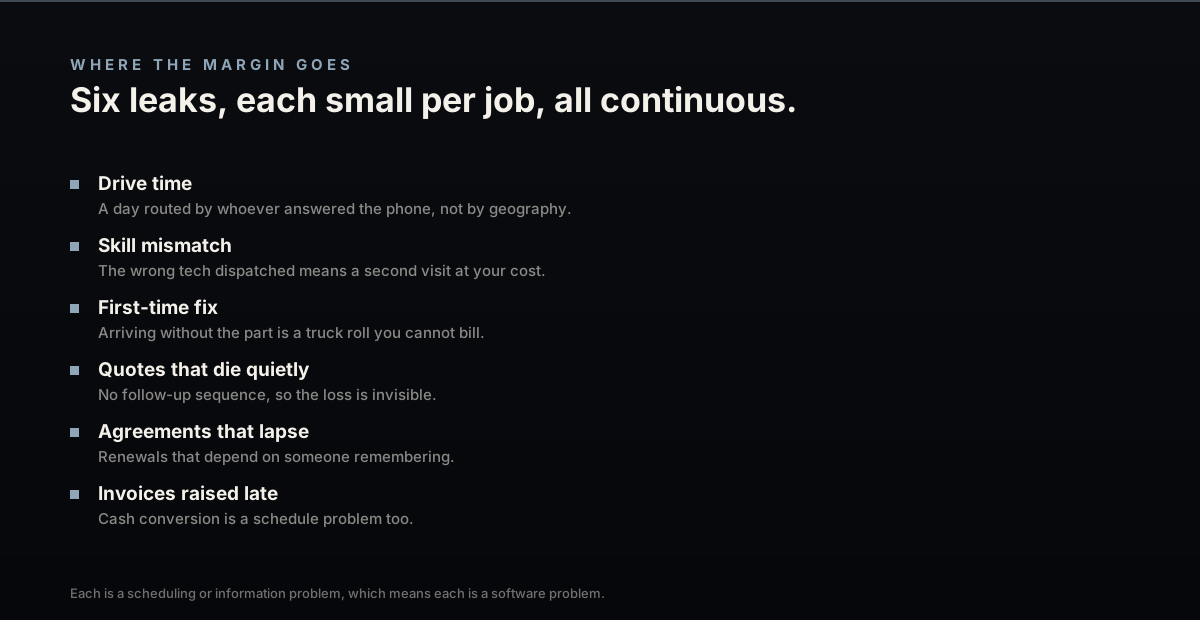
- Drive time. A day routed by whoever answered the phone costs an hour or more per technician against a day routed by geography and skill.:
- Skill mismatch. Sending the person who cannot commission that unit produces a second visit at your cost.:
- First-time fix rate. A technician arriving without the part is a truck roll you paid for and cannot bill.:
- Quotes that die quietly. A written quote with no follow-up sequence converts far worse than one with, and nobody notices because the loss is invisible.:
- Maintenance agreements that lapse. Recurring revenue leaks when renewals depend on someone remembering.:
- Invoices raised days later. Cash conversion is a schedule problem too.:
The pattern is consistent: each leak is small per job and continuous. We have written about the routing version of this and about the follow-up version, because they show up in every field trade, not only in heating and cooling.
Buy the Platform First
Field service platforms exist and the good ones are worth their fee. Dispatch board, mobile app, invoicing, payments, and price books, all maintained by someone else. For a company running a handful of trucks, buying is the right decision and building would be a waste of capital.
Two things eventually push companies off them. The first is per-seat pricing that scales with headcount, so growth raises the bill in lockstep. The second is the model mismatch that appears when your business is not shaped like the average customer: commercial contracts alongside residential, a parts operation, subcontractors, or a service agreement structure the platform does not recognize.
A platform is a good deal while your business looks like the one it was designed for. The cost of the difference is paid in workarounds.
What a Custom Build Is Actually For
Not to replicate a field service platform. That is a large product and rebuilding it from scratch is a bad trade. The build is worth doing where the leverage is specific to you.
- Dispatch logic that encodes your rules: skill, certification, territory, van stock, and contract priority, applied automatically instead of by memory.
- A customer and equipment record that tracks the unit, not only the address, so history follows the machine through owners and technicians.:
- Maintenance agreements as first-class records, generating the next visit and the renewal without anyone watching a calendar.:
- Quote follow-up as an automated sequence with a real conversion number attached to it.:
- One source of truth that your website, your phone system, and your accounting package all read from.:
In practice that is a database, an admin surface for the office, and automation running the sequences. The dispatch board can stay bought if it is working. The parts that carry your specific advantage come home. That is the shape of the CRM and dashboard work and the workflow automation behind it.
The Website Is Part of the Operation
Emergency work is won on response, and response starts before anyone picks up. A form that lands in an inbox is slower than a form that creates a job, checks the schedule, and offers a window. In a trade where the customer is phoning three companies in a row, minutes decide who gets the job, which is the argument for treating speed to lead as an operational metric and not a marketing one.
The same applies to being found at all. Local search is where emergency demand starts, so the site and the profile behind it are part of the dispatch system in everything but name.