
Ask four companies to quote the same website and the numbers will not be close. One comes back at a few hundred dollars a month with no setup fee. One comes back at several thousand up front. One quotes an hourly rate and no total. The instinct is to assume the expensive one is padding. Usually it is not. They are quoting different things, and the quote rarely says which.
There are four variables that actually move the number. If you can get a straight answer on each one, you can compare quotes properly. If a vendor will not answer them, that itself is the answer.
1. Is it built, or is it assembled?
The cheapest quotes are a purchased theme with your logo and copy dropped into it. That is a legitimate product and for some businesses it is genuinely enough. But you should know that is what you are buying, because it determines everything downstream: you inherit the theme's page weight, its plugin dependencies, and its update cycle, and you will look like every other business that bought the same theme.
A custom build costs more because someone designs and writes it. The practical difference shows up later. When you need a page to do something the theme did not anticipate, a custom build changes; a theme gets a plugin bolted on, and that plugin is now your security surface.
2. Does it need a backend?
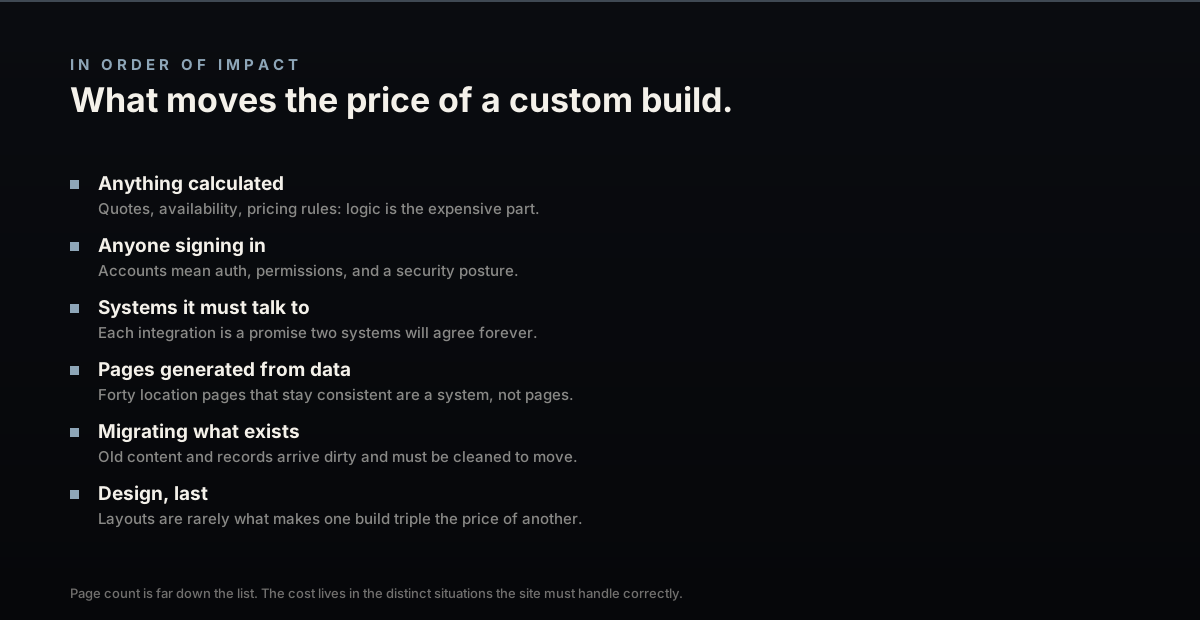
This is the single biggest fork in the price, and it is the one most quotes leave ambiguous. A site that presents information is one job. A site that stores records, applies rules, routes a lead, holds a deposit, or keeps two systems in agreement is a different job, because it needs application logic and a database behind it.
Be specific when you ask. 'Can customers book?' is not enough. Ask whether the booking checks real staff availability, whether it writes to a database you own, and whether it can take a deposit. Those three answers separate a contact form from a system.
3. Who owns it when you leave?
Low monthly pricing with no setup fee is usually a lease. The site is on the vendor's platform, the customer data is in their schema, and when you stop paying you stop having a website. That is not necessarily a bad deal, but it is a rental, and it should be compared against rentals rather than against something you own.
The questions that settle it: can you export your customer records in a usable relational form, can the site be moved to hosting you control, and who holds the domain registration. If the answer to any of those is unclear, the exit cost is higher than the monthly fee suggests.
4. What does the monthly fee actually cover?
A managed fee should be itemized. Hosting, backups, uptime monitoring, vulnerability monitoring, software updates, and a defined number of content changes are all real work with real cost. A monthly fee that covers only hosting is priced like hosting. A monthly fee that includes security monitoring and remediation is doing something materially different.
The failure mode to avoid is a build with no ongoing plan at all. An unmaintained site does not stay where you left it. Dependencies age into known vulnerabilities, and a compromised site usually shows up as a quiet redirect or an injected page that destroys your search rankings before anyone notices.
The costs that are always separate
Some things are genuinely not the developer's to bundle, and a quote that hides them is understating the total. Third-party software licenses, ad spend, telephony and SMS charges, payment processing fees, and AI model usage are consumption costs that scale with your volume, not with the build. Ask for them to be listed separately so you can forecast them.
How to compare two quotes honestly
- Scope: how many pages, and does any of it require backend logic or a database
- Ownership: can you export the data and move the site, and who holds the domain
- Security: is there a review before launch, and is there monitoring after it
- Maintenance: what is included monthly, stated as specific work rather than 'support'
- Exclusions: which third-party and usage costs sit outside the quote
- Change process: what happens when you want something added mid-build
A fixed implementation price with defined deliverables is easier to evaluate than an hourly rate, because it moves the estimating risk to the vendor. Paying in stages, with the working build shown partway through, means you see something real before the balance is committed.
The cheapest website is the one you replace once. The expensive one is the one you replace every two years because it was never yours to change.
None of this argues that custom is always right. A single-location business that needs a credible presence and nothing else is well served by something simple. The argument is narrower: know which of the four things above you are buying, because the price difference between quotes is almost entirely explained by them.