
There is a quiet shift happening underneath every AI product on the market. Access to the most capable models is consolidating into a small number of labs, and the terms of that access are tightening. The models are getting more powerful, but the conditions attached to using them, who is allowed in, what it costs, and what the model will agree to do, are moving in the wrong direction for anyone trying to run a business on top of them.
The strategic answer is not to wait for the gates to open. It is to stop renting access to intelligence and start owning it. Open-weight models have closed the capability gap on the work that actually runs a business, and they do it on infrastructure you control. This is the case for that shift, with the numbers and the regulatory record behind it.
Access Is Becoming Conditional
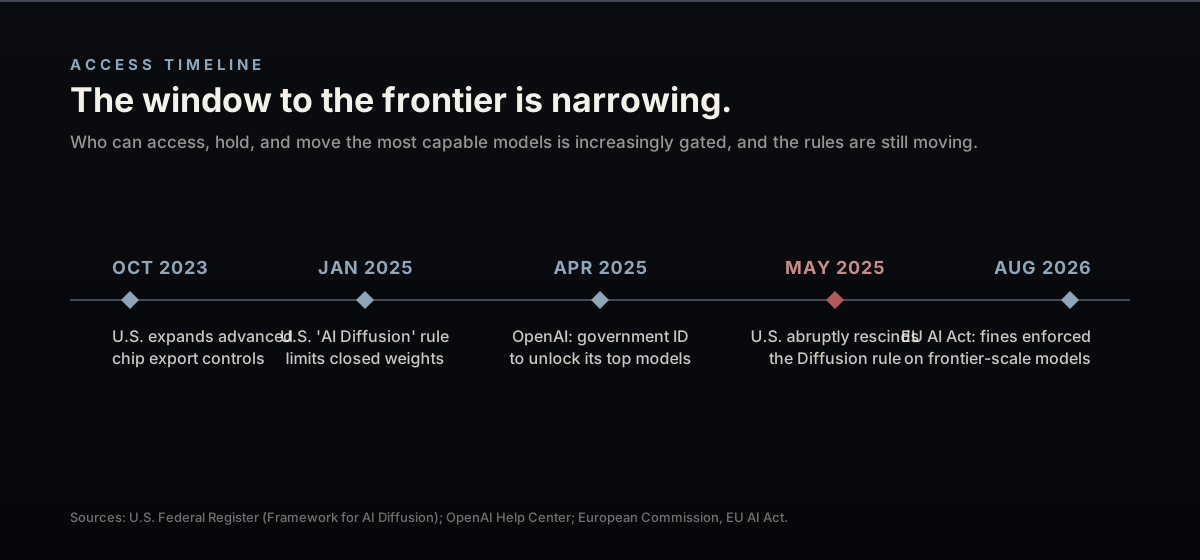
In April 2025, OpenAI introduced Verified Organization, a process that requires a valid government-issued ID to unlock access to its most advanced models and capabilities. A single ID can verify only one organization every 90 days, and by OpenAI's own description, not all organizations will be eligible. Read that plainly: the most capable proprietary intelligence is no longer something you can simply pay for and use. It is something you apply for.
Regulation is moving the same direction. Under the EU AI Act, any general-purpose model trained on more than 10^25 FLOP is presumed to carry 'systemic risk' and inherits a heavier compliance regime. Provider obligations began on 2 August 2025, and from 2 August 2026 the Commission can enforce them with fines. The exact compute threshold that defines a 'frontier' model is now written into law, and it moves as hardware improves.
How unsettled this all is shows up clearly in the United States. In January 2025, the Commerce Department's Bureau of Industry and Security published the 'Framework for Artificial Intelligence Diffusion', a rule that, for the first time, put a worldwide license requirement on exporting the weights of closed-weight models trained above a compute threshold, alongside controls on large clusters of AI chips. Four months later, in May 2025, the administration rescinded the rule days before it took effect, calling it overly bureaucratic. The point is not which side was right. The point is that the rules governing who can hold and move frontier models are real, contested, and capable of reversing in a single quarter.
The Output-Token Tax
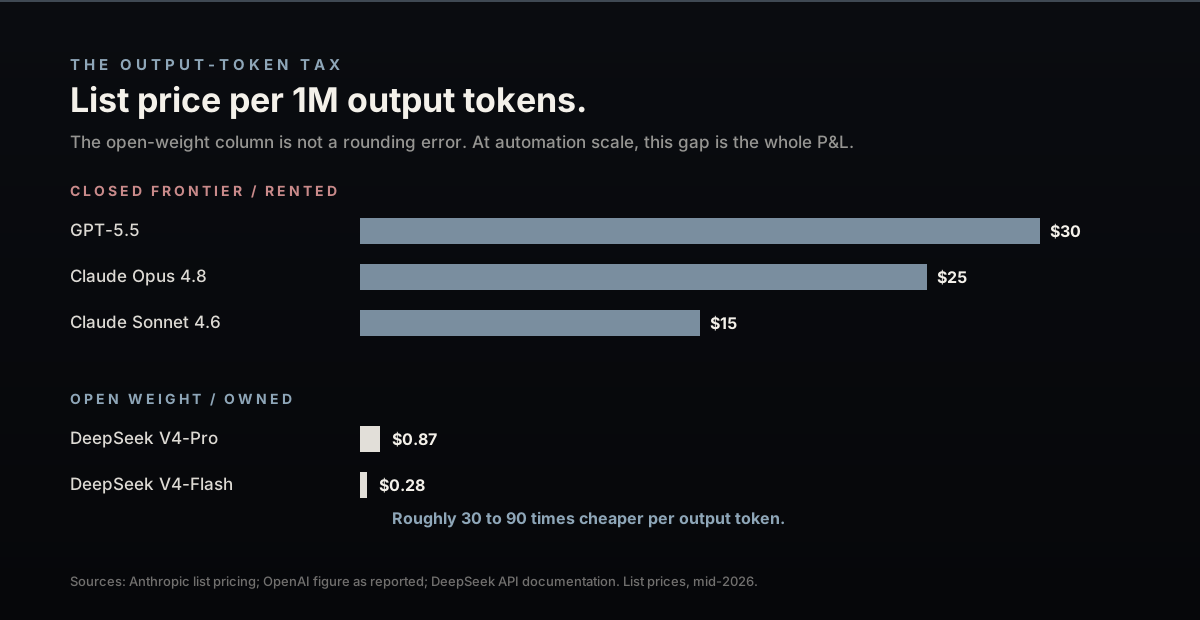
Then there is the bill. Frontier access is priced like a scarce resource because, increasingly, it is being treated as one. At list prices, a leading closed model runs about $5 per million input tokens and $25 per million output tokens, with the very top tiers reaching far higher. Open-weight models from the current generation, the kind you can run yourself, are priced from roughly $0.14 to $0.44 per million input tokens and $0.28 to $0.87 per million output tokens.
That is a gap of roughly 30 to 90 times on output tokens. For a chat demo, the difference is invisible. For an operation that runs thousands of automated agent steps a day, follow-ups, routing, drafting, support, reporting, it is the difference between automation being a feature and automation being the single largest line item on the bill. Cost is not a footnote here. At scale it decides whether the system is worth running at all.
Open Weights Closed the Capability Gap
None of this would matter if open-weight models were second-rate. They are not anymore. On the independent leaderboards that track the work that runs a business, tool calling, instruction following, and multi-step agentic task completion, open-weight models now sit at or near the top alongside the closed frontier. Public benchmarks like the Berkeley Function Calling Leaderboard, SWE-bench, Artificial Analysis, and LMArena tell a consistent story: the capability lead the closed labs once held has narrowed to the point where, for most operational work, it no longer shows up in the result.
There is also a quieter, practical advantage. Frontier assistants are tuned to refuse and to reset to their own identity. Ask one to stay in a defined operational role and it will frequently break character, decline routine work, or announce what it is instead of doing the task. An agent that runs a business cannot stall on a refusal in the middle of a workflow. Open-weight models, configured and constrained properly, execute the workflow instead of negotiating with it.
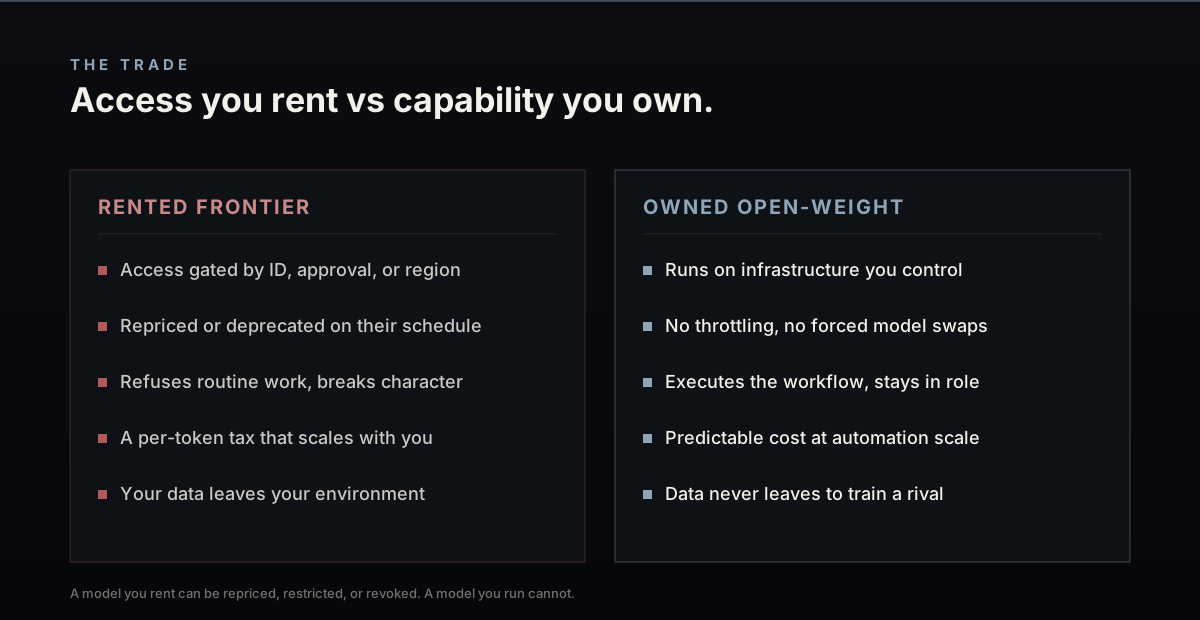
A model you rent can be repriced, restricted, or revoked. A model you run cannot.
Rented Access vs Owned Capability
The strategic difference is ownership. A rented frontier model can be gated behind approval, repriced without notice, deprecated on someone else's schedule, and pointed at your data on the way through. An owned open-weight model runs inside infrastructure you control. It cannot be throttled or swapped underneath you, its cost is predictable, and your data, and your customers' data, never leaves to train someone else's model. The capability is comparable. The control is not.
The Catch: It Is Hard to Build
This is where the advantage becomes asymmetric. Almost no one knows open-weight models can match the gated frontier, and far fewer can actually build with them. The setup is unforgiving. Tool calling, context handling, quantization, serving, evaluation, and version drift each have a dozen ways to go wrong, and one wrong move leaves you stuck in build loops, broken tool calls, and silent failures that degrade quietly until something breaks in production. The capability is open. The competence to deploy it is not. That gap is the moat.
That is the part CASRA absorbs. We have already paid the learning cost, the failed configurations, and the hardening work, so the business on the other side does not have to. You get a configured, evaluated, production-grade system built on the most powerful open-weight models available, and an edge you own instead of access someone else can revoke. The frontier is closing. The leverage is in owning what runs underneath it.
Sources
- OpenAI Help Center: API Organization Verification (government ID, one ID per organization per 90 days). https://help.openai.com/en/articles/10910291-api-organization-verification
- European Commission: General-Purpose AI obligations and the 10^25 FLOP systemic-risk threshold under the EU AI Act. https://digital-strategy.ec.europa.eu/en/policies/regulatory-framework-ai
- U.S. Federal Register: Framework for Artificial Intelligence Diffusion (Jan 2025), subsequently rescinded May 2025. https://www.federalregister.gov/documents/2025/01/15/2025-00636/framework-for-artificial-intelligence-diffusion
- Anthropic: published API list pricing for Claude models. https://www.anthropic.com/pricing
- DeepSeek: official API pricing documentation for open-weight models. https://api-docs.deepseek.com/quick_start/pricing