
The two things look identical to a visitor. A box in the corner, a greeting, a text field. What happens behind the box is different enough that comparing them on price is meaningless.
What a Chatbot Widget Does
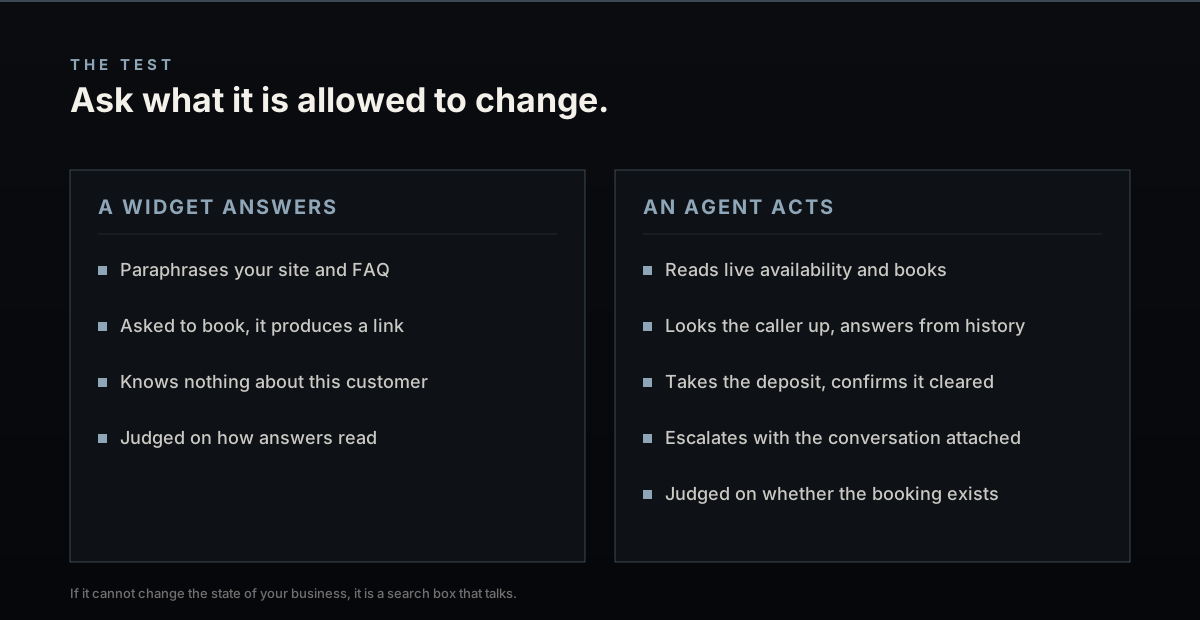
A widget answers questions from a body of text. Point it at your site and your FAQ, and it will paraphrase them convincingly. That is genuinely useful for deflecting questions about opening hours, parking, and whether you cover a postcode.
Its limit is that it has no ability to change anything. Asked to book, it produces a link. Asked about an existing order, it does not know one exists. Asked something outside its text, a well-built one says it does not know and a badly built one invents an answer, which is worse than silence because a customer will act on it.
What an Agent Does
An agent is given tools and permission to use them. Not a general intelligence loose in your business: a defined set of operations it may perform, each one a function against a real system, with the boundaries written down.
- Read live availability across staff, rooms, and equipment, then hold and confirm a slot.:
- Look up a customer by phone number and answer from their actual history.:
- Qualify an inquiry against your criteria and route it, instead of dropping every lead into one inbox.:
- Take the deposit, or send the payment link and confirm when it clears.:
- Escalate to a person with the conversation attached, so the customer does not repeat themselves.:
- Write everything it did to a log you can audit afterwards.:
The difference is accountability. A widget can be judged on whether its answers read well. An agent can be judged on whether the appointment exists, and that is a question with a yes or no answer.
If it cannot change the state of your business, it is a search box that talks.
Why the Cheap Version Often Makes Things Worse
A widget that cannot act still absorbs the customer's attention. They ask it to reschedule, it explains that it cannot, and they leave. The inquiry that would have been a phone call becomes nothing. Deflection is only a saving when the thing doing the deflecting resolves the request.
The second failure is confident wrongness. A model given no tools and no grounding will fill gaps. Quoting a price you do not offer, or promising a Saturday you do not work, creates a dispute with a customer holding a transcript. That risk is managed by giving the model a narrow job, real data, and an explicit instruction to escalate when it is unsure.
What an Agent Costs That a Widget Does Not
It has to be built against your systems. A widget is a script tag; an agent needs somewhere to read availability from and somewhere to write a booking to. Businesses without a real system underneath discover that the agent project is a systems project wearing a different hat. That is usually the honest finding, and it is better to hear it before the invoice.
It also needs evaluation and a place to fail safely. Every tool call is something happening in the real world, so the boundaries, the escalation path, and the logs are not polish. They are the product. We treat them that way in the AI agent work, and the workflow automation underneath is what makes the actions possible.
Choosing Between Them
- High volume of repetitive questions, nothing to transact: a widget is the right size of solution.
- Inquiries that are worth money and arrive out of hours: an agent that can book pays for itself on the appointments a widget loses.
- No system of record yet: build that first. An agent with nothing to read from is a chatbot with a longer invoice.
- Regulated or high-stakes advice: keep the model away from the answer and use it to route to a human quickly.
The test is simple. Ask what the thing is allowed to change. If the answer is nothing, price it as a widget and expect widget results.